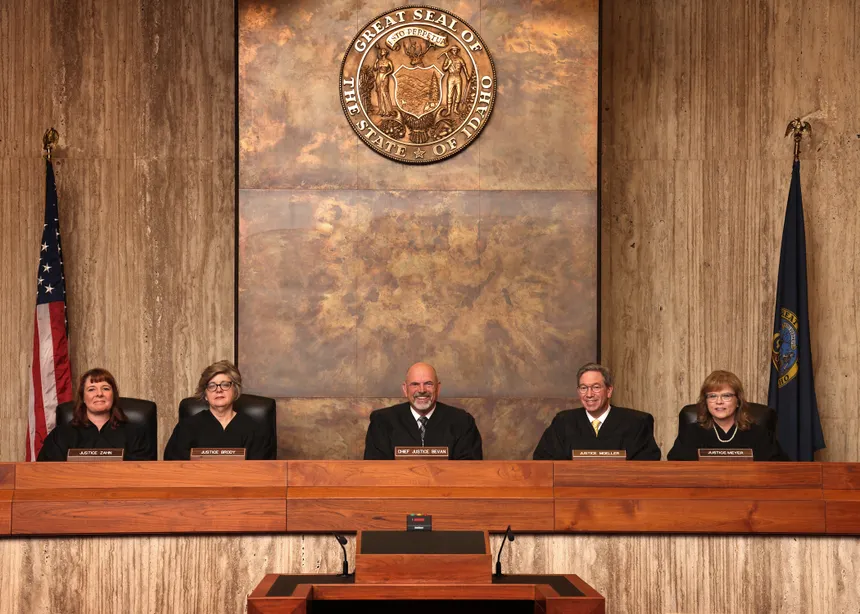
BOISE, Idaho — The Idaho Supreme Court heard oral arguments Friday in a lawsuit challenging the state’s new Parental Choice Tax Credit, a $50 million program that allows families to use state funds for private and home-based education expenses.
During the hearing, several justices questioned whether the Idaho Constitution prevents the Legislature from supporting educational options outside the public school system.
The case centers on House Bill 93, which was passed by the Legislature and signed into law by Gov. Brad Little last year. The program offers refundable tax credits to eligible families for qualifying education costs.
Justices Probe Constitutional Language
Attorneys representing a coalition of education groups argued that the Idaho Constitution requires the state to fund only a public school system and that the tax credit creates a separate, private education structure.
The coalition includes the Idaho Education Association, the Moscow School District, advocacy organizations, and several individual parents and educators. They contend the tax credit diverts public resources away from public schools and lacks sufficient oversight.
The constitutional debate focused on Article IX, Section 1, which directs the state to establish and maintain a “general, uniform and thorough” system of public education. Coalition attorneys said this language limits state funding to public schools only.
Several justices expressed skepticism toward that interpretation, noting the wording does not explicitly prohibit other educational investments.
Questions Raised About Standing and Impact
The court also examined whether the coalition has legal standing to challenge the program. Some justices questioned whether the plaintiffs demonstrated a direct and measurable injury, rather than a hypothetical one.
The coalition argued that public school enrollment and funding could decline as families use the tax credit to choose private or home education options. Attorneys said the court must intervene because state agencies declined to challenge the law.
State Defends Tax Credit Structure
Attorneys for the state and the Legislature argued that the Constitution sets a minimum requirement for funding public education, not a restriction on other education-related spending.
They emphasized that the tax credit reimburses parents, not schools, and can be used for tutoring, books, assessments, and other educational materials in addition to tuition.
State attorneys also said the program does not create or maintain a separate school system because participation is voluntary and private schools are not regulated by the state under the law.
Oversight Standards Discussed
To qualify for reimbursement, private or home-based education providers must be accredited or maintain student portfolios demonstrating instruction in core subjects such as math, English, science, and social studies.
Justices questioned whether these requirements amount to the state maintaining a parallel education system. Attorneys for the Legislature responded that the standards are eligibility conditions for families, not regulations imposed on schools.
Broader Implications Raised
One justice asked whether ruling against the tax credit could affect other state programs, including Idaho Launch, which provides scholarships for both public and private postsecondary education.
Coalition attorneys said their challenge applies only to K–12 education, though the court noted that any decision could have wider implications for state education policy.
Thousands Apply for Credits
The Idaho State Tax Commission reported that more than 4,650 applications had been submitted as of midweek, covering more than 7,300 students. Families can apply through March 15 unless the program is paused by a court order or legislative action.
The tax credit allows families to receive up to $5,000 per student, or $7,500 for students with disabilities. Priority is given to households earning up to 300% of the federal poverty level during the initial application period.
Decision Expected to Be Final
The Idaho Supreme Court’s ruling will determine whether the program moves forward. Because the case is based on the state constitution, the decision is expected to be final once issued.
The court did not indicate when a ruling will be released.
Related Coverage
- Idaho News – https://idahonews.co/idaho-news-3/
- National News – https://idahonews.co/national-news/
- Global News – https://idahonews.co/global-news/
About the Author