Strong Quake Prompts Nationwide Advisory
Japan has issued a broad advisory for the possibility of a major offshore earthquake after a magnitude 7.5 quake struck the country’s northern region. Authorities say at least 34 people suffered mostly minor injuries, and crews are assessing damage to roads, buildings, and coastal infrastructure.
Government officials emphasized that the advisory is not a prediction but a warning informed by historical patterns. Japan estimates that a large offshore event in the region could generate a tsunami approaching 100 feet and result in large-scale casualties comparable to the 2011 disaster.
The probability of a magnitude 8 or greater quake remains low, roughly one percent, but authorities say the recent shaking increases the likelihood of additional activity in the coming week. Residents in coastal areas are being urged to keep emergency supplies ready and be prepared to evacuate immediately if conditions worsen.
Where the Quake Struck
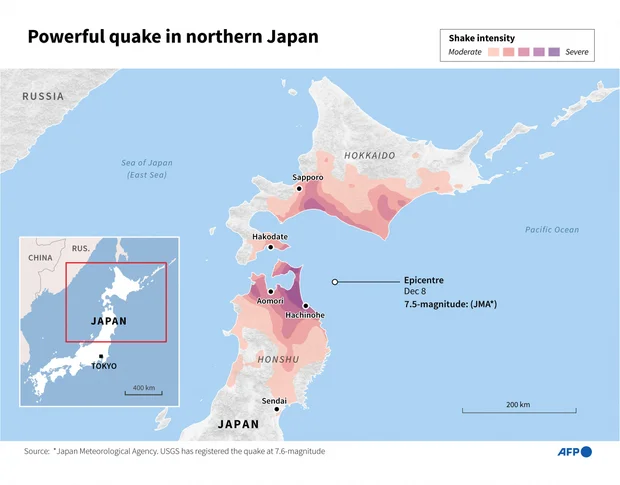
The Japan Meteorological Agency reports that the earthquake occurred offshore near Aomori Prefecture at the northern tip of Honshu, just south of Hokkaido. The region sits near the Japan Trench and Chishima Trench, fault systems responsible for many of the country’s largest historical earthquakes.
Residents in nearby communities described strong, prolonged shaking. A civil servant in Hashikami said his family ran outside as the ground moved for roughly 20 seconds, reminding him of the 2011 event that devastated coastal towns and damaged the Fukushima Daiichi nuclear plant.
Increased Seismic Risk Along Northern Coast
The advisory covers 182 municipalities stretching from Hokkaido to Chiba Prefecture. Officials say the concern stems from the pattern seen in 2011, when a magnitude 7.3 quake preceded a magnitude 9.0 event two days later. The 2011 tsunami exceeded 50 feet in some areas and caused long-lasting concerns about radiation exposure after flooding the Fukushima facility.
Government models show a similar offshore quake today could generate a tsunami as high as 98 feet in parts of the Hokkaido–Sanriku region. A scenario of that scale could kill nearly 200,000 people, destroy more than 200,000 buildings, and produce economic losses approaching 31 trillion yen. Winter conditions could add to the risk, with tens of thousands potentially facing hypothermia.
Previous Advisory for Southern Coastline
Japan maintains a separate advisory system for potential megaquakes tied to the Nankai Trough in the south. That alert was activated for the first time last year following a magnitude 7.1 quake near Miyazaki. Earlier government estimates suggested a Nankai event could generate a tsunami surpassing 30 feet and lead to more than 300,000 deaths.
Officials Urge Preparation Without Panic
Government spokespeople stress that the new advisory is precautionary. The guidance encourages people to continue daily life while taking steps to prepare. Recommended actions include keeping an emergency kit with several days of basic supplies, wearing easily removable clothing during sleep, and securing furniture to prevent tipping.
Local governments have updated online guidance, reviewed disaster supplies, and tested communication equipment for evacuation centers. Some municipalities are encouraging residents to subscribe to emergency alert systems.
Past advisories caused confusion due to technical explanations that left many unsure how to respond. That led to temporary shortages of food and basic supplies in some regions. Officials say this year’s guidance aims to prevent unnecessary panic while ensuring readiness.
Related Coverage
Idaho News – https://idahonews.co/idaho-news-3/
National News – https://idahonews.co/national-news/
Global News – https://idahonews.co/global-news/
About the Author