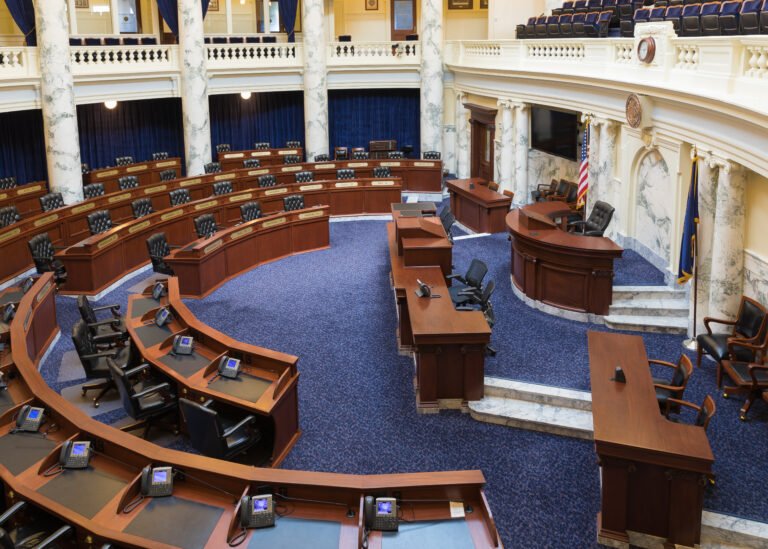
The Idaho State Capitol in Boise. File photo.
Proposition 1, the reproductive-rights initiative on the November ballot, would establish a statutory right to reproductive freedom and privacy. It would recognize abortion decisions up to fetal viability—defined as the point when a fetus has a significant likelihood of sustained survival outside the uterus without extraordinary medical measures, based on a physician’s good-faith judgment—and allow post-viability abortions in cases of medical emergency. The emergency standard covers a physical condition that warrants abortion to protect the patient’s life or health, including serious jeopardy, impairment of a bodily function, or dysfunction of a bodily organ, again determined by a physician’s good-faith judgment. The measure would also protect related care such as contraception, fertility treatment, and miscarriage management from government interference unless the restriction is narrowly tailored to health through the least restrictive means. It is a statutory change, not a constitutional amendment, and it would take effect in 2027 if approved.
Idaho’s existing post-Dobbs framework is among the nation’s more restrictive. Refining its medical exceptions, clarifying the standard of care for life-threatening complications, and addressing hospital staffing are legitimate legislative tasks. Prop 1 goes further by creating a viability standard with a defined health exception afterward. That is a substantial liberalization, not a minor clarification of current law. Voters who believe the state has a continuing interest in protecting unborn life can reject the measure without dismissing the practical difficulties created by the present statute.
A 2025 study in JAMA Network Open found a net reduction in the number of OB-GYNs practicing obstetrics in Idaho after the law took effect. That finding is not the same as every obstetrician leaving the state, nor does it establish that the abortion statute caused every departure or every maternity-ward closure. Those distinctions matter. The staffing and access problems are real for women who must travel for care; attributing every change solely to the statute overstates what the available evidence shows.
The better path is to keep refining the existing medical exceptions through the legislature and the courts rather than adopt a viability framework. Physicians need clear guidance on what constitutes a medical emergency. Women facing severe health risks need timely care. Those goals can be pursued without establishing a broader statutory right that reaches viability. Rejecting Prop 1 would leave lawmakers responsible for addressing those problems; it would not make them disappear.
Idahoans can weigh the measure’s actual scope against the state’s current law and decide whether the proposed change matches their priorities. The campaign will feature strong claims from both sides. The text itself—abortion rights before fetal viability, a post-viability health exception defined by physical conditions, and statutory rather than constitutional status—provides the clearest basis for that judgment.
Sources
About the Author